
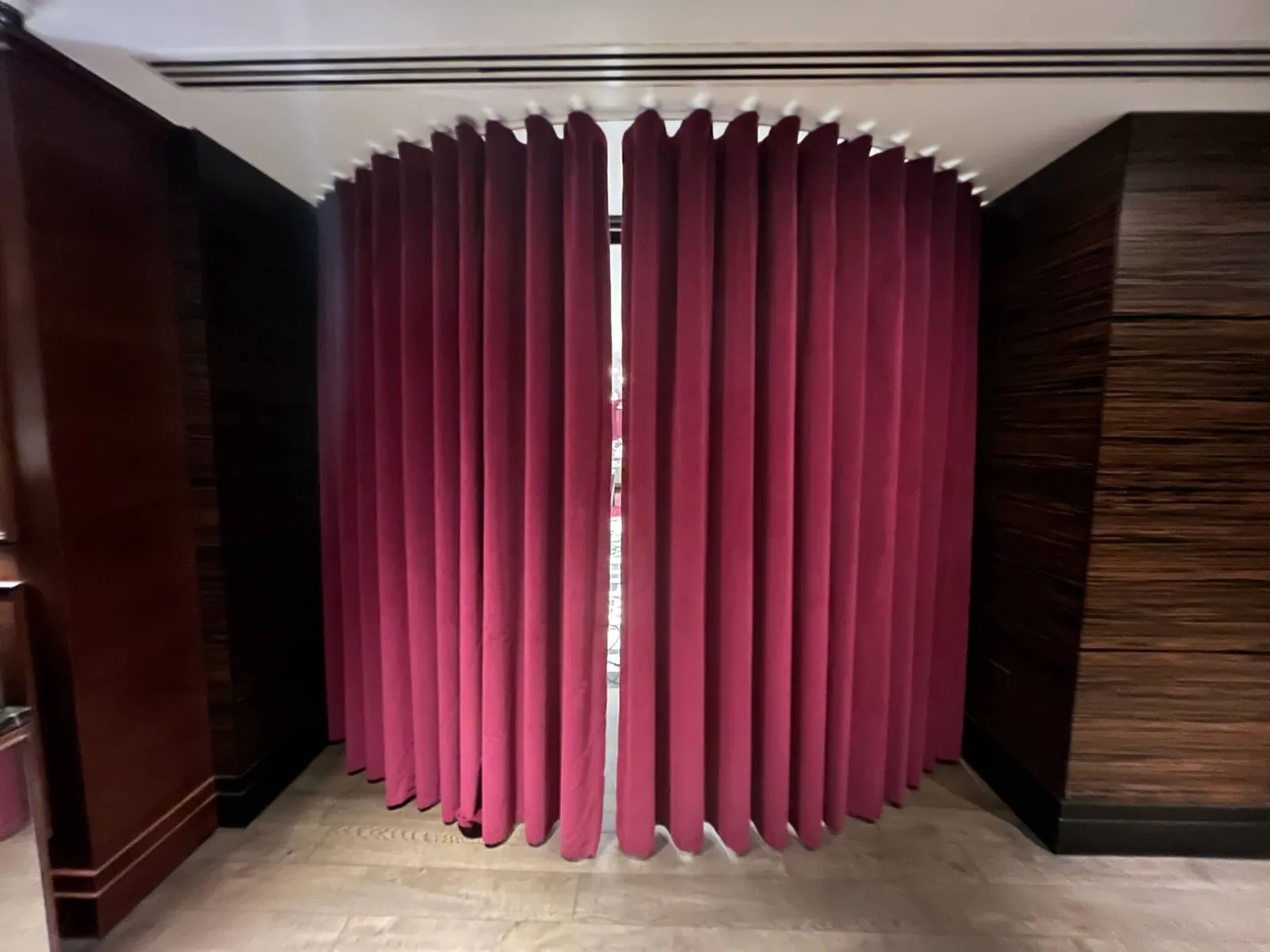
The direct answer: curtains in an ordinary private residential tenancy are not automatically required to meet BS 5867. Holiday lets, serviced accommodation and other properties used by paying guests have different fire-safety responsibilities, and their curtains may need to meet BS 5867 Part 2 Type B.
The property’s fire risk assessment should identify what is required.
01 · Residential rentals
Ordinary residential rental properties
Curtains are not covered by the Furniture and Furnishings (Fire) (Safety) Regulations 1988. These regulations apply to specified upholstered furniture and furnishings supplied with rented accommodation, including sofas, chairs, mattresses and cushions.
They do not create a blanket requirement for curtains in every privately rented house or flat to be fire retardant.
Additional requirements may still apply to houses in multiple occupation, shared or communal areas, licensed accommodation, properties with insurer requirements, or curtains specifically identified in a fire risk assessment.
Landlords and managing agents should follow the requirements applying to their particular property rather than assuming that every rental is treated in the same way.
Official guidance confirms that curtains are excluded from the Furniture and Furnishings (Fire) (Safety) Regulations: Bath and North East Somerset Council — safety of goods in rented accommodation.
02 · Paying guests
Holiday lets and paying-guest accommodation
Holiday cottages, Airbnb properties, serviced apartments, guest houses and other short-term accommodation are used by paying guests.
These properties require a fire risk assessment. Government sleeping-accommodation guidance identifies BS 5867-2 as the relevant standard for curtain and drape fabrics, including nets and linings.
BS 5867 Part 2 Type B is the standard normally requested for curtains in this type of accommodation. The requirement may apply to bedroom curtains, lounge and dining-area curtains, door curtains, decorative drapes, nets, linings and curtains in shared spaces.
The fire risk assessment should confirm which curtains need to be covered.
What is BS 5867 Part 2 Type B?
BS 5867 Part 2 Type B concerns the flammability performance of curtain and drape fabrics. Fire-retardant treatment is designed to help the fabric resist ignition and limit continued burning after the ignition source is removed.
Read our BS 5867 Part 2 Type B guide →Official sleeping-accommodation guidance identifies BS 5867-2 for curtains, drapes, nets and linings: GOV.UK — fire safety risk assessment for sleeping accommodation.
03 · Existing curtains
Can existing rental curtains be treated?
Yes. Absorbent natural or synthetic curtain fabrics can be fire-retardant treated while hanging.
This avoids removing, transporting and rehanging the curtains, which is particularly helpful when several rooms or properties are involved.
Lined curtains are treated as complete curtains, with both the face fabric and lining included in the treatment calculation.
Do the curtains need cleaning first?
Curtains that are already clean can be treated directly.
Dusty, marked or heavily soiled curtains should be cleaned before fire-retardant treatment. This is particularly relevant in accommodation where curtains may have been hanging for several years without professional cleaning.
Cleaning and fire-retardant treatment can be completed during one planned visit, with the treatment applied after cleaning.
04 · Certificate and aftercare
What happens after curtains are treated?
A Certificate of Fire Retardant Treatment is supplied after treatment and payment.
The certificate records the property, the curtains covered by the work and the completed BS 5867 Part 2 Type B treatment. It should be retained with the property’s fire risk assessment and other fire-safety records.
The certificate also includes maintenance and retreatment information.
Does washing remove the treatment?
Water washing and water-extraction cleaning remove the fire-retardant treatment, so the curtains must be treated again afterwards.
Routine vacuuming does not remove the treatment and is a useful way to control dust between professional cleans.
Fire Proofing Ltd certificates state that retreatment is required after five years or five dry-cleaning cycles, whichever occurs first.
Can treatment avoid curtain replacement?
Existing absorbent curtains can often be treated rather than replaced. This is particularly useful for made-to-measure curtains, unusually large windows, matching interiors and properties with several rooms.
05 · Common questions
Rental-curtain questions
Do curtains in an ordinary rental property have to be fire retardant?+
There is no blanket UK rule requiring every curtain in every ordinary residential tenancy to meet BS 5867. Curtains are outside the scope of the Furniture and Furnishings (Fire) (Safety) Regulations, although other licensing conditions, risk assessments or insurer requirements may apply.
Do holiday-let curtains need to meet BS 5867?+
Holiday lets and other paying-guest accommodation require a fire risk assessment. Government sleeping-accommodation guidance identifies BS 5867-2 as the relevant standard for curtain and drape fabrics.
Can curtains be treated without taking them down?+
Yes. Absorbent curtains can be treated on site while hanging.
Do clean curtains need cleaning before treatment?+
No. Curtains that are already clean can receive fire-retardant treatment directly.
Will I receive a certificate?+
Yes. A BS 5867 Part 2 Type B treatment certificate is supplied after the work is completed and payment is received.