
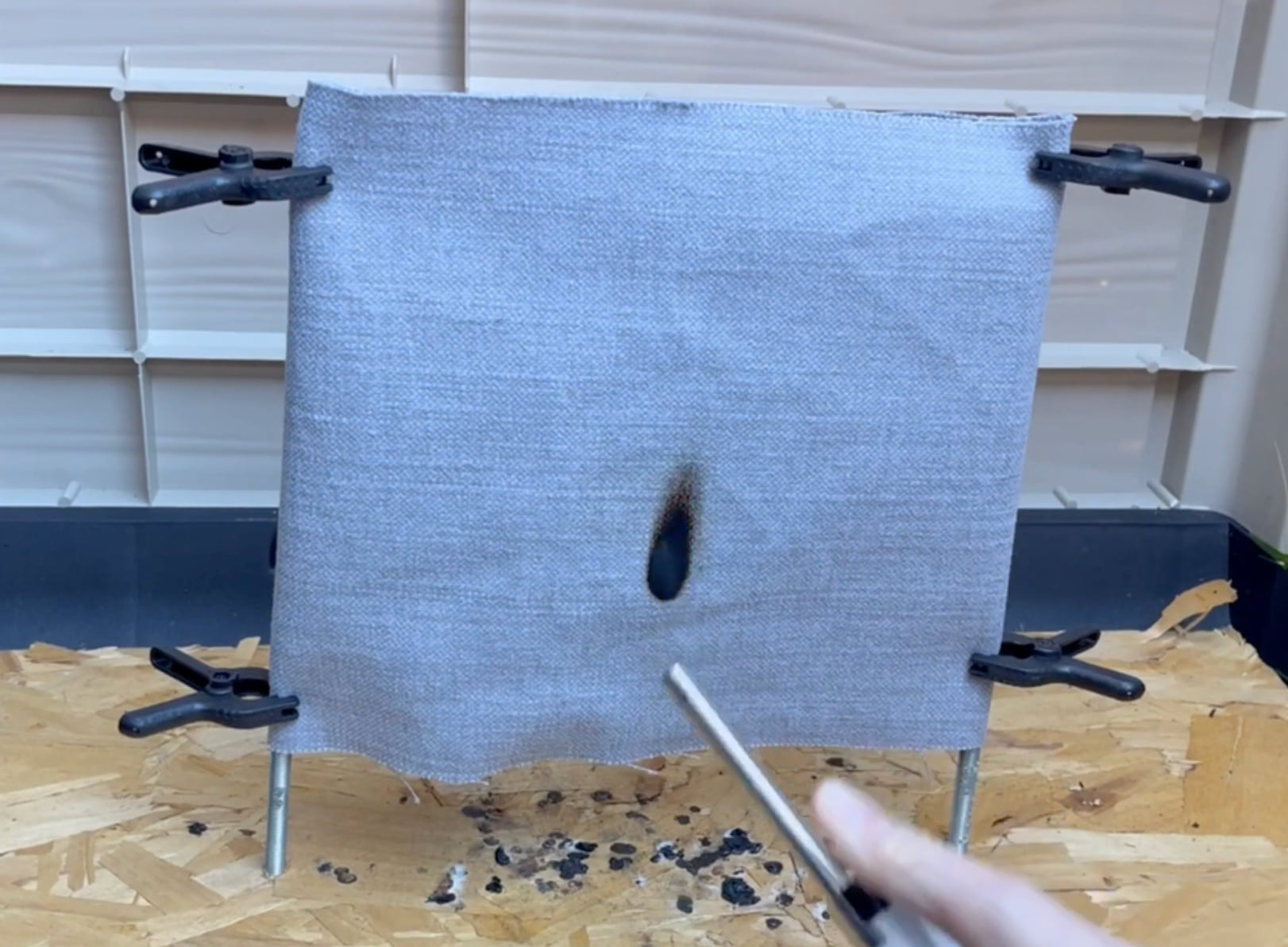
It assesses how curtain fabric behaves when exposed to a defined flame. The Type B requirements limit flame and hole spread and prevent flaming debris from separating from the fabric.
What does BS 5867 Part 2 Type B mean?
BS 5867 is the British Standard for fabrics used to make curtains, drapes and window blinds. Part 2 covers the flammability requirements for these fabrics and finished curtain assemblies. Type B describes the fire-retardant performance normally required in public and commercial settings.
During testing, representative fabric samples are mounted vertically and exposed to a controlled flame. The way the material reacts is then assessed against the Type B criteria.
A Type B result does not mean that the curtain is non-combustible or completely fireproof. It means the tested fabric or curtain assembly has achieved the defined fire-retardant performance required by the standard. It is not the same as a fire curtain designed to divide areas of a building or provide fire resistance.
01 · Where it applies
Which curtains does BS 5867 Part 2 Type B cover?
BS 5867 Part 2 applies to fabrics and fabric assemblies used for non-domestic curtains, drapes and window blinds.
This includes curtains found in theatres, schools, village halls, churches, hotels, care homes, offices, public buildings, hospitality venues and managed commercial properties.
- Theatres, stages and auditoriums
- Schools, colleges and universities
- Village halls and community venues
- Hotels, care homes and hospitality venues
- Face fabric
- Linings and interlinings
- Fabric blinds
- Other layers in the finished assembly
The standard covers more than the visible face fabric. Linings, interlinings and other layers used in the completed curtain assembly may also need to be considered. This is why information about the complete curtain construction is important when arranging testing or fire-retardant treatment.
Primary reference: BSI Knowledge — BS 5867-2:2008.
02 · The test
How is BS 5867 Part 2 Type B tested?
Representative samples are conditioned and mounted vertically before being exposed to a defined propane flame for 15 seconds.
Samples are tested in both fabric directions because the construction can behave differently along the warp and weft.
Type B pass criteria
- The flame must not reach an edge of the specimen.
- A hole created by the flame must not reach an edge.
- Flaming debris must not separate from the specimen.
The result applies to the fabric or curtain assembly represented by the test sample. A change to the fabric, lining, coating or construction may affect how the completed curtain performs.
03 · Existing curtains
Can existing curtains be treated to BS 5867 Part 2 Type B?
Yes. Existing curtains made from absorbent fabric can be treated, whether the fibres are natural or synthetic.
The important factor is absorbency. The fabric must be able to absorb the water-based fire-retardant product. A simple fabric test can confirm absorbency when the composition or previous finish is unknown.
Curtains can normally be treated while they remain hanging. This is particularly useful for large stage curtains, theatre drapes and other installations that would be difficult or expensive to remove.
Lined curtains can also be treated. The lining and complete treated area must be included when calculating the amount of product required.
04 · Documentation
What is a BS 5867 Part 2 Type B treatment certificate?
After fire-retardant treatment, a Certificate of Fire Retardant Treatment records the work completed on the identified curtains.
The certificate normally includes the curtains or drapes covered, the venue or treatment location, treatment date, fire-retardant product used, completed treatment, BS 5867 Part 2 Type B requirement and relevant care information.
The curtains or drapes covered by the treatment.
The location, date, product and completed work.
Keep the certificate with the venue’s relevant compliance records.
The certificate should be retained with the venue’s fire-safety, insurance and compliance records.
05 · Cleaning and retreatment
How long does BS 5867 Part 2 Type B treatment last?
Fire Proofing Ltd treatment certificates state that curtains require retreatment after five years or five dry-cleaning cycles, whichever occurs first. Each professional dry-cleaning cycle counts towards the five-clean limit.
Water washing and water-extraction cleaning remove the water-soluble treatment applied by Fire Proofing Ltd. Curtains cleaned using either method must be retreated.
Earlier retreatment is also required when new curtain panels are added, the original curtains are substantially altered, they have been affected by significant water damage or the previous treatment history cannot be confirmed.
Careful routine vacuuming does not count as a dry-cleaning cycle. It can help control dust and reduce how frequently deeper cleaning is required.
06 · Common questions
BS 5867 Part 2 Type B FAQs
Is BS 5867 Part 2 Type B for domestic curtains?+
BS 5867 Part 2 covers curtains, drapes and fabric blinds used in non-domestic premises. Curtains in an ordinary private home do not normally require this treatment.
Does Type B mean the curtains are fireproof?+
No. Type B describes a defined level of fire-retardant performance. The curtains are not non-combustible and do not become a fire-resisting barrier.
Can natural and synthetic curtains be treated?+
Yes. Natural and synthetic curtain fabrics can both be treated when the material is absorbent.
How can fabric absorbency be checked?+
A small amount of liquid can be used to assess whether the fabric absorbs a water-based treatment. Fire Proofing Ltd provides free fabric testing when absorbency needs to be confirmed.
Can lined curtains be treated?+
Yes. The face fabric and lining are included in the treatment calculation so the complete curtain can be treated.
Can curtains remain hanging during treatment?+
Yes. Curtains can normally remain hanging while the fire-retardant product is professionally applied and allowed to dry.
What certificate is supplied after treatment?+
A Certificate of Fire Retardant Treatment is supplied after treatment and payment. It identifies the curtains treated and records the BS 5867 Part 2 Type B requirement.
When do curtains need retreating?+
Fire Proofing Ltd certificates state that retreatment is required after five years or five dry-cleaning cycles, whichever comes first. Washing or water-based cleaning requires earlier retreatment.