
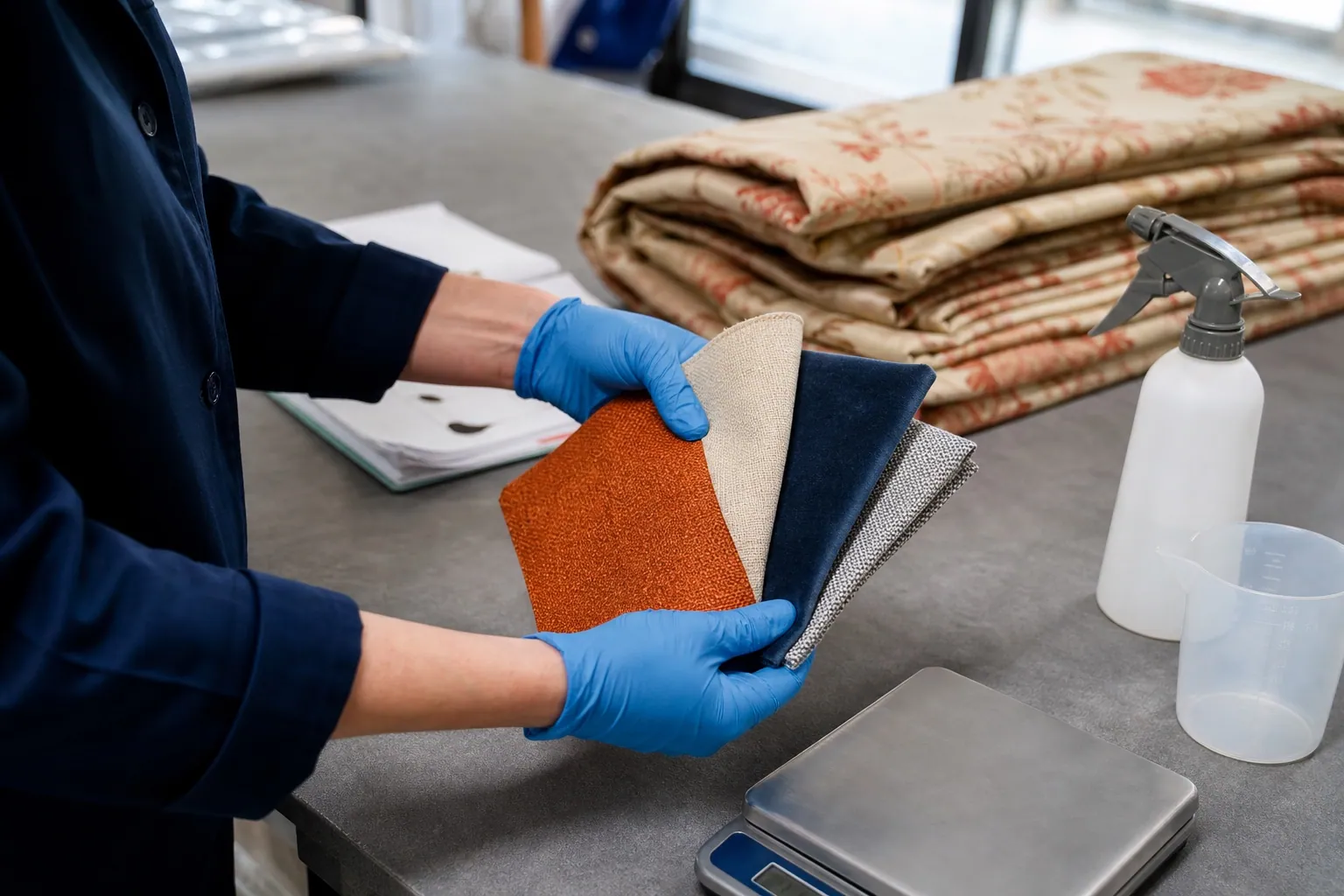
The direct answer: The most serious mistake is treating fire retardant as a universal spray. Different fibres, fabric constructions and finishes can need different specialist products, concentrations and application rates. A competent person must assess the material and select the appropriate system.
Treatment is intended to improve defined flammability behaviour. It does not make a textile non-combustible, guarantee safety in every fire or turn a curtain into a fire-resisting barrier.
01 · Material assessment
Mistake: assuming one product suits every fabric
Cotton, polyester, linen and mixed-fibre fabrics do not all behave in the same way. Coatings, waterproofing, stain-resistant finishes, linings, previous treatments and contamination can also affect absorbency and the finished result.
Labels and product specifications are useful, but they are not always available. Practical textile experience helps a competent person identify the likely composition from the construction, appearance and handle, then select the specialist formulation appropriate to that material. Where suitability remains uncertain, a representative sample or further information may be needed.
- Fibre label or specification
- Fabric construction and thickness
- Linings and multiple layers
- Coatings or protective finishes
- Water-repellent surfaces
- Unknown previous treatments
- Poor or uneven absorption
- Existing damage or contamination
02 · In-house demonstration
How untreated fabric behaves when ignited
This short in-house demonstration shows the behaviour observed when flame is applied to untreated fabric. It illustrates why the starting material must be understood before a treatment system is selected.
Behaviour under ignition
The demonstration records how the material continues to burn after flame is applied.
What this video shows: This is a practical in-house demonstration of untreated material behaviour. It is not an accredited laboratory test, does not assign a formal classification and is not a treatment certificate.
03 · Product and application
Mistake: using the wrong quantity or applying it unevenly
Even the correct product must be prepared and applied at the rate appropriate to the identified fabric. Too little can leave areas insufficiently treated. Excess or uneven application can affect drying, appearance or handle without creating a better result.
- 01Identify
Establish the likely fibre composition, construction and relevant finishes.
- 02Select
Choose the specialist product and process supported for that material.
- 03Calculate
Use the measured area and material requirements to determine the application quantity.
- 04Apply and dry
Treat consistently and allow adequate drying before curtains are handled or used.
04 · Fabric appearance
Mistake: ignoring how a fabric may react when wet
Many treatment systems are water based, so the textile can move temporarily as it becomes wet and dries. Linen can react in different ways: it may tighten or sag. Sagging normally recovers during drying, while tightening that remains once dry can usually be manipulated.
Colour, drape, handle, seams and existing condition should be considered before treatment. Where appearance is especially sensitive, a representative sample can help identify how the material is likely to respond.
05 · Evidence and responsibility
The certificate your venue or insurer needs
After suitable curtains or fabrics have been treated, Fire Proofing Ltd issues a Certificate of Fire Retardant Treatment. It confirms that the identified items were assessed and treated by a competent person using the specialist product and application process selected for the material.
This certificate is valid evidence of compliant treatment to the applicable standard and is the formal record retained for the venue, responsible person, fire-risk assessor or insurer. For routine BS 5867 treatment certification, supporting laboratory data does not normally need to accompany it unless specifically requested.
The certificate states which curtains or fabrics and location were treated.
It records the selected specialist product and treatment process.
It states the cleaning and retreatment limits that apply.
Curtains and drapes in public and commercial places are required to comply with BS 5867. Part 2 Type B is the normal requirement for most public-place curtains, with Type C applying where the higher performance level is specified. Our competent assessment, treatment and certification provide the evidence customers need.
06 · Cleaning and retreatment
Mistake: treating the certificate as permanent
Fire Proofing Ltd certificates state that retreatment is required after five years or five dry-cleaning cycles, whichever occurs first. Washing or another cleaning process that removes or materially affects the treatment can require earlier reassessment and retreatment.
Practical curtain care
- Vacuum curtains regularly to remove surface dust
- Use careful textile-safe methods and suitable equipment
- Regular vacuuming helps retain a pristine appearance
- Good routine care can reduce the need for dry cleaning
- Keep a record of dry-cleaning cycles
- Retain the treatment certificate with fire-safety records
07 · Before requesting treatment
Information that helps us assess the work
Start with the measurements, quantity, intended use, site location, known fibre composition and any fire-safety wording you have received.
We are happy to discuss the project by telephone before information is sent, particularly where the material, standard or certificate request is unclear.
08 · Common questions
Curtain and fabric treatment questions
Does one treatment product work on every fabric?+
No. Different fibres, constructions and finishes can require different specialist products, concentrations and application rates. The material must be assessed first.
Can treatment change the appearance of fabric?+
Some fabrics move temporarily when wet. Linen may tighten or sag, although sagging normally recovers while drying and residual tightening can be carefully manipulated once dry.
What certificate is issued after treatment?+
Fire Proofing Ltd issues a Certificate of Fire Retardant Treatment confirming competent, compliant treatment of the identified items using the selected specialist system and process. It is valid evidence for venue, insurer and fire-safety records.
When is retreatment required?+
Our certificates require retreatment after five years or five dry-cleaning cycles, whichever occurs first. Washing or cleaning that removes the treatment can require earlier retreatment.
Are photographs required for a quotation?+
No. Measurements, quantity, site location, known composition and the required fire-safety wording are more important starting details.