
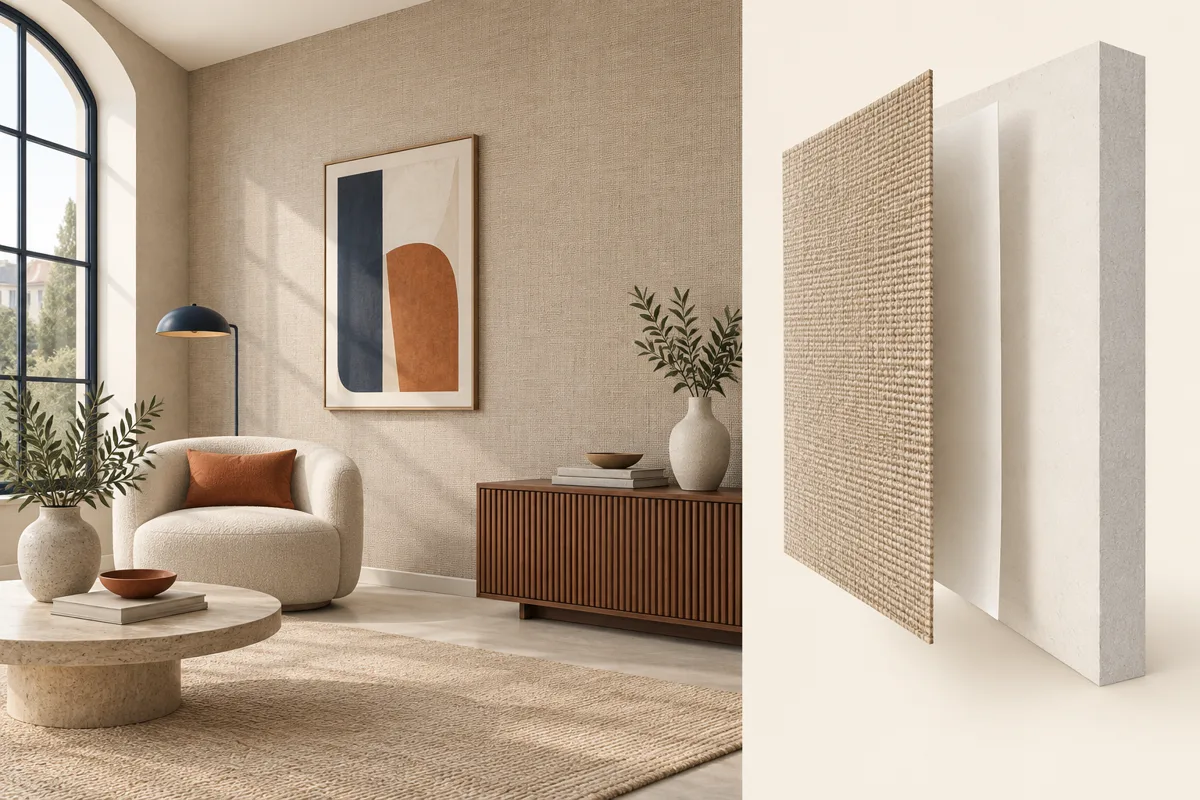
01 · Understanding the reference
What is BS EN 15102?
If you are specifying fabric for an interior wall or reviewing an existing installation, you may have encountered BS EN 15102. It is a product standard for decorative wallcoverings, addressing characteristics including reaction to fire and the release of certain substances.
It is not the name of a fire-retardant treatment or one overall pass-or-fail fire test.
BS EN 15102:2019 covers decorative wallcoverings in roll form applied with adhesive to internal walls, partitions and ceilings, including textile wallcoverings. Other constructions, such as stretched fabric or upholstered panels, need their applicable requirements established separately.
Addresses the wallcovering product and its declared characteristics.
Provides the classification system used to describe reaction-to-fire performance.
A curtain test result does not automatically establish the performance of the same fabric used as a wallcovering.
02 · Fire-retardant treatment
Can fabric be sprayed to achieve the standard?
Treatment may improve a fabric’s fire performance, but spraying alone does not establish compliance with BS EN 15102.
Fire-retardant treatment can form part of a wallcovering specification where appropriate evidence supports its use. The starting point is to identify the required fire classification and whether that evidence covers the proposed construction.
The fabric, backing, adhesive and supporting surface can all matter. A treatment certificate records the work carried out; it does not, by itself, establish every applicable wallcovering characteristic or the classification of an installed wall finish.
03 · Planning the installation
Installing fabric, then having it sprayed?
Resolve the fire-performance specification before choosing the fabric and installation method. This gives you time to consider the materials together and establish whether existing evidence covers the arrangement or further assessment is needed.
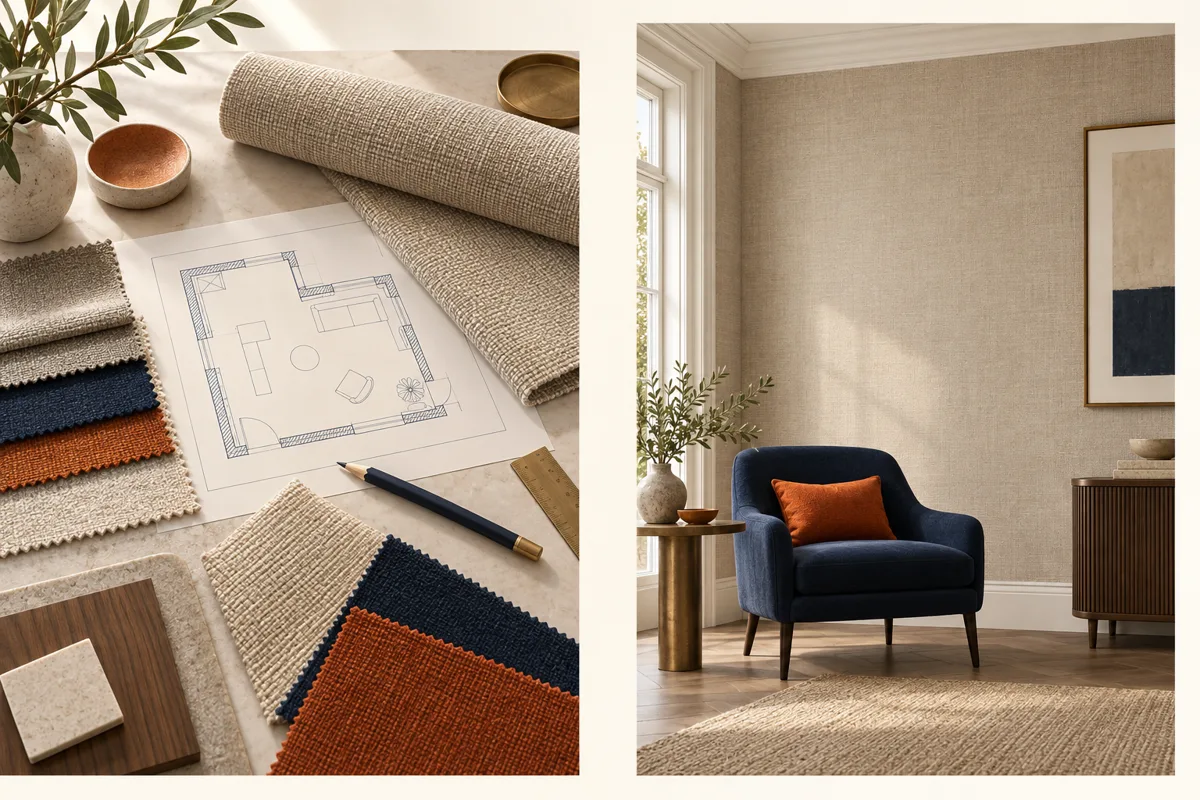
Installing first and arranging treatment afterwards can leave an evidence gap: improving the exposed fabric’s fire performance may not establish the classification required for the complete wall finish.
What if the fabric is already installed?
An existing installation needs to be considered on its own facts. Bring together:
- The fabric and any backing or padding.
- Whether it is bonded, stretched or otherwise fixed.
- The supporting surface, adhesive and any air gap.
- Existing product information and fire-performance evidence.
- The performance required for the project.
The relevant supplier, fire specialist or testing laboratory can then advise on the evidence needed and whether treatment is a viable part of the solution.
04 · Understanding the evidence
What does each document tell you?
Different documents answer different questions. Check that they identify the fabric or wallcovering being specified, including its finish and intended use.
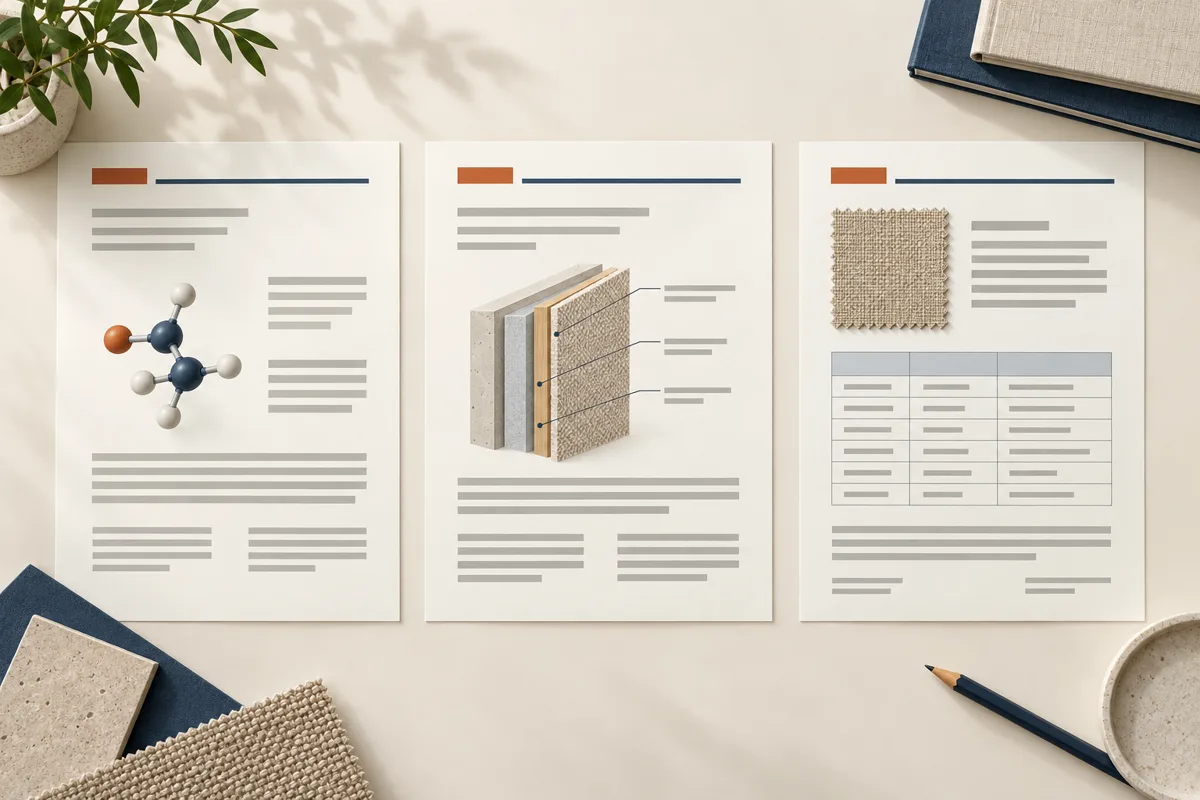
A useful starting point
- Product declaration: the intended use and declared performance, including a Declaration of Performance where applicable.
- Fire classification: the class achieved and the installation conditions it covers.
- Chemical information: evidence addressing the relevant substances or emissions.
- Installation instructions: the specified adhesive, supporting surface and fixing method.
Does OEKO-TEX certification demonstrate compliance?
Suppliers may provide certification such as OEKO-TEX® STANDARD 100, which assesses textiles against that scheme’s requirements for harmful substances. This is useful evidence about the chemical characteristics covered by the certification.
It does not establish a reaction-to-fire classification or, by itself, demonstrate compliance with BS EN 15102.
Where it is offered as supporting evidence, ask which requirements it addresses and whether it covers the specific fabric and finish. Its relevance depends on the substances, methods and limits assessed.
Supporting evidence can contribute to an assessment without being equivalent to compliance with the complete wallcovering standard.
05 · Editions and scope
Why do documents show different editions?
BSI’s current publication is BS EN 15102:2019, covering roll-form wallcoverings. The latest Great Britain designated-standards notice linked below lists EN 15102:2007+A1:2011, whose title covers roll and panel form.
The current published edition and the edition designated for regulatory purposes can therefore differ. An older reference is not automatically incorrect, and the removal of panels from the 2019 edition does not settle every panel product’s regulatory position.
Check the edition, intended use and applicable market when reviewing a declaration. This guide does not provide a product-marking procedure.
06 · Common questions
Questions at specification stage
Does every wallcovering need the same fire class?+
The required performance depends on the project and applicable requirements. BS EN 15102 is not a universal instruction to use one fire class everywhere.
Does every product require a new fire test?+
Not necessarily. Existing evidence may cover the product and proposed use, and classification without further testing is possible under defined conditions. The applicable route needs to be established for the product.
Is reaction to fire the same as fire resistance?+
No. Reaction to fire concerns a product’s contribution to fire. Fire resistance concerns the performance of a building element, such as a complete wall, over a period of time.
Sources & further reading
Explore the supporting information
- BSI: BS EN 15102:2019 — scope and publication details
- GOV.UK: designated standards for construction products
- GB designation notice 0123/25 — EN 15102 at entry 406
- EN 15102:2019 public preview — selected pages
- OEKO-TEX: what STANDARD 100 certification covers
Reviewed 28 September 2026. This introductory guide uses the published scope, public standard preview and sources above. Product-specific decisions require evidence relevant to the proposed installation. Images are generated illustrations, not completed projects or tested constructions.
Related reading: Fabric wallcoverings and BS EN 13501-1.